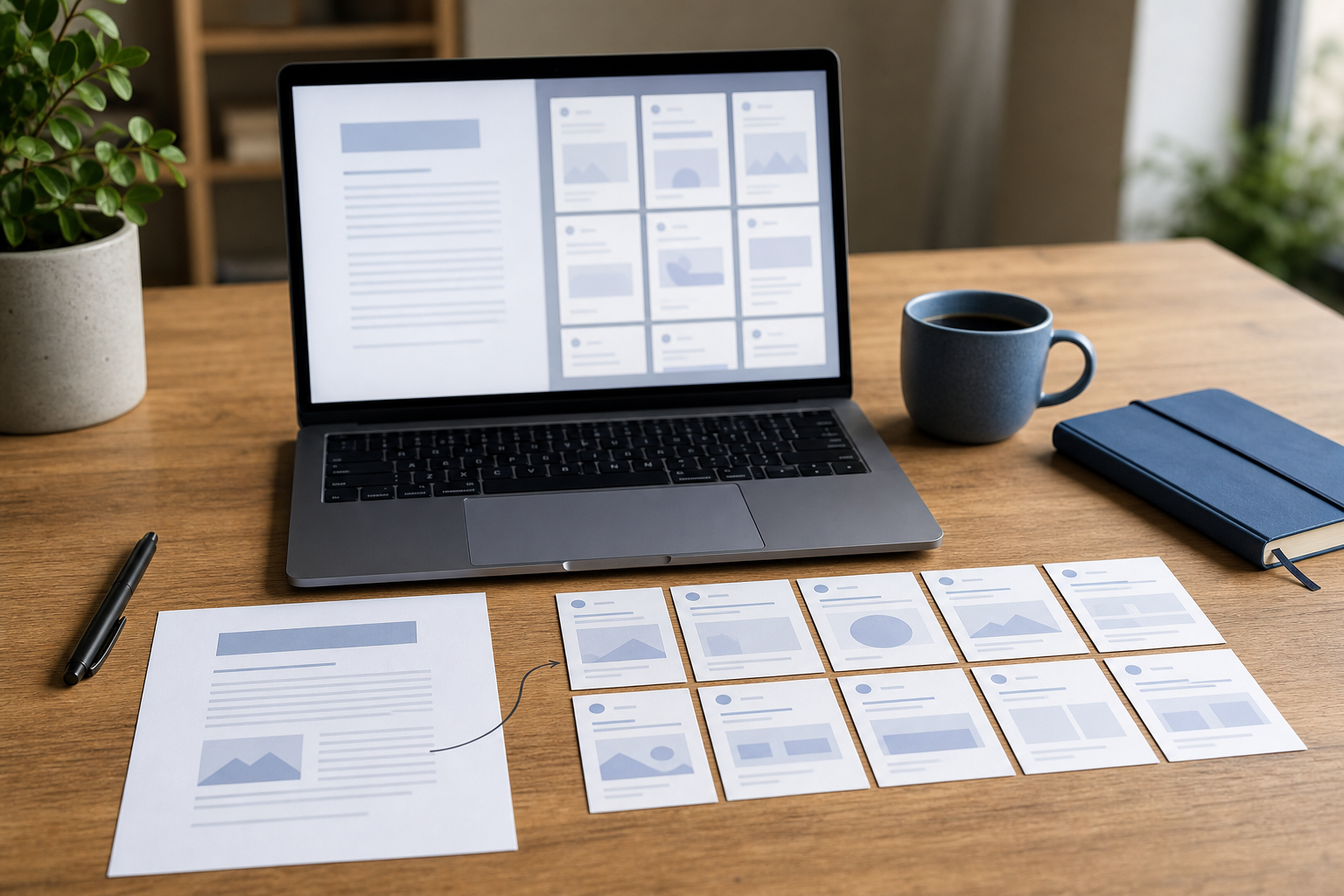
A finished article often contains more useful ideas than one social update can carry. The difficulty is not asking AI to “make ten posts.” That broad request usually produces repetitive summaries, invented claims, and captions that all sound alike.
A better way to repurpose a blog post with AI is to treat the article as a controlled source. First extract its strongest ideas, then assign a distinct purpose to each social post, draft within clear boundaries, and review every claim against the original.
This guide shows you how to build a 10-post repurposing pack from one article. You will leave with a source sheet, an angle map, copy/paste prompts, a review table, and a reusable human QA checklist. The workflow is platform-neutral, so you can adapt the drafts to the channels you actually use.
Table of Contents
- Who This Workflow Is For
- What You Will Create
- Inputs You Need
- The 7-Step Workflow
- Copy/Paste Prompt Pack
- Example 10-Post Plan
- Limitations and Common Mistakes
- Human QA Checklist
- FAQ
- Conclusion
Who This Workflow Is For
This process is useful for bloggers, solopreneurs, newsletter writers, and small content teams that already have a reviewed article and want several social drafts without losing the article’s meaning.
It is especially helpful when:
- you want multiple angles rather than ten near-identical summaries;
- you need a repeatable system that an editor or assistant can follow;
- factual accuracy matters;
- you publish on more than one channel;
- you want AI to accelerate drafting while keeping final decisions human.
It is not a good fit when the source article is unfinished, poorly sourced, or outside your right to reuse. If you are working from someone else’s article, do not feed it into a rewriting workflow and present the result as your own. Start with content you own or have permission to repurpose.
What You Will Create
The final deliverable is a small content pack with five parts:
- Source sheet: the article’s verified claims, examples, steps, and cautions.
- Audience note: who should care and what problem the article helps them solve.
- 10-post angle map: a different job for each post.
- Draft set: ten editable social posts with source references.
- QA log: a record of claim, tone, link, and platform checks.
The goal is not to squeeze every paragraph into social media. It is to select ten useful entry points into the same underlying article.
Inputs You Need
Gather these before opening your AI tool:
| Input | What to include | Why it matters |
|---|---|---|
| Final article | The reviewed article, not an early draft | Prevents the pack from preserving deleted errors |
| Reader profile | Role, experience level, main problem | Keeps examples and wording relevant |
| Brand voice | Three to five traits plus phrases to avoid | Reduces generic or off-brand output |
| Verified source notes | URLs and claim notes used for the article | Makes fact-checking faster |
| Channel list | Only channels you really use | Avoids unnecessary format work |
| Constraints | Length, CTA, hashtag, emoji, and link rules | Gives each draft a practical boundary |
If your source material is scattered, organize it first with the AI note cleanup workflow. A clean source makes repurposing much easier to review.
The 7-Step Workflow to Repurpose a Blog Post with AI
Step 1: Freeze the Reviewed Source
Create a clean copy of the final article and label it as the source version. Include the title, publication date, URL if available, and last review date. Remove navigation, ads, unrelated sidebar text, and comments before giving the text to AI.
Add this instruction above the article:
Treat the supplied article as the only content source. Do not add statistics, quotes, examples, product claims, or outcomes that are not explicitly supported by it. Mark missing information as
NEEDS REVIEW.
This boundary does not guarantee accuracy, but it gives you a clear standard for checking the output.
Step 2: Build a Source Sheet
Do not draft social posts yet. First ask AI to extract reusable building blocks. Each item should include a source location, such as the heading or a short exact phrase that lets a reviewer find it.
Use these source-sheet fields:
| Field | Example type |
|---|---|
| Reader problem | A recurring planning bottleneck |
| Main promise | The concrete output the workflow creates |
| Steps | Actions the reader can follow |
| Practical tips | Small implementation details |
| Mistakes | Behaviors that weaken the result |
| Limitations | Situations requiring caution |
| Questions | Useful prompts for discussion |
| Quotable lines | Original lines from your own article only |
Delete weak or duplicate items. If the article supports only six genuinely distinct ideas, do not force ten factual lessons. Some posts can instead use a question, checklist, process view, or invitation to read the full guide.
Step 3: Define One Audience and One Objective
Write a two-sentence brief:
- Audience: Who is this pack for?
- Objective: What should the reader understand or do after seeing it?
For example:
Audience: solo bloggers who have useful long-form posts but no repeatable repurposing process. Objective: help them turn one reviewed article into a varied draft pack while preserving source accuracy.
Keep the objective practical. Avoid instructions that demand engagement, virality, or other outcomes the draft cannot ensure.
Step 4: Assign 10 Distinct Post Jobs
Variation should come from purpose, not from swapping adjectives. Give every post one job before drafting.
A balanced set might include:
- problem recognition;
- counterproductive habit;
- quick tip;
- mini how-to;
- checklist;
- framework;
- example application;
- limitation or caution;
- reflection question;
- article summary and next step.
Check the angle map for overlap. If two rows communicate the same lesson, merge them and choose another source-backed angle.
Step 5: Draft in Small Batches
Generate two or three posts at a time rather than all ten in one request. Small batches make it easier to compare tone, identify repetition, and correct drift before it spreads through the pack.
For each draft, require:
- the assigned post job;
- one central idea;
- a source-sheet reference;
- a suggested format;
- a low-pressure next step;
- a
NEEDS REVIEWlabel for unsupported details.
Ask for plain text first. Platform formatting can come later.
Step 6: Run a Diversity and Accuracy Pass
Place all ten drafts in a table and ask AI to identify repetition. Use AI here as a critic, not as the final authority.
Review four types of duplication:
- Opening duplication: too many posts start with the same question or claim.
- Idea duplication: different wording presents the same lesson.
- Structure duplication: every post uses three bullets and a final question.
- CTA duplication: every draft says “read more” in the same way.
Then compare every factual sentence with the article. If a draft introduces a number, quote, outcome, or example that the article does not support, remove it or research it separately before use.
Step 7: Adapt, Schedule, and Record Decisions
Only after the core drafts pass review should you adapt them to a channel. Different channels may favor different lengths or layouts, but you do not need unsupported claims or exaggerated hooks to make a post readable.
For each final draft, record:
- selected channel;
- planned date;
- final copy;
- link destination;
- image or visual note;
- reviewer;
- approval status.
Scheduling ten posts does not mean publishing all ten at once. Choose a cadence that fits your audience and editorial capacity, and recheck time-sensitive references before each post goes live.
Copy/Paste Prompt Pack
Replace the bracketed text before use. For long articles, attach or paste the source in a separate clearly labeled block.
Prompt 1: Extract the Source Sheet
You are helping me repurpose a blog post with AI while preserving its meaning.

Use only the supplied article. Do not add facts, statistics, quotes, examples,
features, or outcomes that are not in the source.

Create a source sheet with these columns:
1. ID
2. Type: problem, step, tip, mistake, limitation, question, or original quote
3. Reusable idea
4. Source heading
5. Short source phrase for reviewer lookup
6. Review note

Merge duplicates. Mark uncertain items NEEDS REVIEW.

ARTICLE:
[PASTE YOUR REVIEWED ARTICLE]
Prompt 2: Create the 10-Post Angle Map
Using the approved source sheet below, create a 10-post angle map for:

Audience: [AUDIENCE]
Objective: [OBJECTIVE]
Brand voice: [3-5 TRAITS]
Avoid: [PHRASES OR TACTICS TO AVOID]

Give each post a different job. Use this mix:
problem, mistake, quick tip, mini how-to, checklist, framework,
example application, limitation, reflection question, and article summary.

Return a table with: post number, job, source IDs, central idea,
suggested format, and overlap risk. Do not draft the posts yet.
Prompt 3: Draft a Small Batch
Draft posts [NUMBERS] from the approved angle map.

Rules:
- Use only the linked source IDs.
- Give each post one central idea.
- Keep the voice [VOICE].
- Do not invent results, quotes, examples, or urgency.
- Do not use clickbait.
- Add NEEDS REVIEW after any statement that cannot be traced to the source.
- End with a useful, low-pressure next step when appropriate.

For each draft return: draft text, source IDs, format note, and review risk.

SOURCE SHEET:
[PASTE APPROVED ROWS]

ANGLE MAP:
[PASTE SELECTED ROWS]
Prompt 4: Audit Variation
Audit these ten social drafts. Do not rewrite them yet.

Identify:
- repeated openings;
- repeated central ideas;
- repeated structures;
- repeated calls to action;
- unsupported facts or examples;
- tone that conflicts with [BRAND VOICE].

Return a table with draft number, issue, severity, evidence, and a specific
revision instruction. If no issue is found, say PASS rather than inventing one.
Prompt 5: Adapt One Approved Draft
Adapt the approved core draft below for [CHANNEL].

Constraints:
- target length: [LENGTH OR RANGE]
- formatting: [FORMAT]
- CTA: [CTA OR NONE]
- hashtags: [RULE]
- emojis: [RULE]
- link: [URL OR NONE]

Preserve the original meaning and source boundary. Do not add a trend,
statistic, outcome, quote, or platform claim. Return the adapted draft and a
one-sentence note describing what changed.

APPROVED CORE DRAFT:
[PASTE DRAFT]
Example 10-Post Plan
Imagine the source article explains how to create a blog post brief. The following plan shows how one article can support ten distinct posts without pretending that every post needs a new fact.
| # | Post job | Central angle | Format | Source check |
|---|---|---|---|---|
| 1 | Problem | Writing starts before the goal is clear | Short observation | Intro/problem section |
| 2 | Mistake | A topic is not the same as a usable brief | Contrast post | Common mistakes |
| 3 | Quick tip | Define one reader before outlining | Single tip | Audience step |
| 4 | Mini how-to | Turn a rough idea into a working angle | Three steps | Workflow section |
| 5 | Checklist | Fields to review before drafting | Checklist | Brief template |
| 6 | Framework | Reader, problem, output, evidence | Four-part framework | Template fields |
| 7 | Application | How a broad topic becomes a specific assignment | Before/after structure | Article example |
| 8 | Limitation | AI cannot verify missing source evidence for you | Caution post | Limitations |
| 9 | Question | Which brief field prevents the most rewrites? | Discussion prompt | Workflow reflection |
| 10 | Summary | Build the brief, then review it before drafting | Article preview | Conclusion |
Notice that this plan mixes educational, reflective, and navigational posts. It does not fabricate ten separate “insights.”
Reusable Tracking Template
| Post | Source IDs | Core draft approved? | Channel version | Link checked? | Visual | Reviewer | Status |
|---|---|---|---|---|---|---|---|
| 1 | Idea | ||||||
| 2 | Idea | ||||||
| 3 | Idea | ||||||
| 4 | Idea | ||||||
| 5 | Idea | ||||||
| 6 | Idea | ||||||
| 7 | Idea | ||||||
| 8 | Idea | ||||||
| 9 | Idea | ||||||
| 10 | Idea |
Limitations and Common Mistakes
The source article may not support ten strong angles
Do not solve a shallow source by asking AI to become more creative. Combine similar angles, add a genuine reader question, or publish fewer posts.
Platform context still requires human judgment
A draft that reads well in a document may feel awkward in a live feed. Check line breaks, link behavior, visual crops, mentions, and current platform controls directly before publishing. This workflow intentionally avoids current feature or character-limit claims because those details can change.
AI can flatten nuance
Summaries may turn a conditional recommendation into a universal rule. Compare words such as “can,” “may,” “often,” and “sometimes” with the source. Small wording changes can materially alter a claim.
Repetition can hide behind surface variation
Changing the hook does not create a new post if the body teaches the same idea. Judge diversity by the reader takeaway, not by vocabulary.
Old articles can produce old social posts
Recheck dates, links, screenshots, product references, and factual claims before repurposing an older article. Refresh the source first when necessary.
A generated pack is not publication approval
Keep drafts in a review queue. A person should approve the copy, source fidelity, context, links, and visuals for each channel.
Human QA Checklist
Use this before approving each post:
Source fidelity
- [ ] Every factual statement can be traced to the reviewed article or its verified sources.
- [ ] Quotes are exact and come from content you own or may reuse.
- [ ] Numbers, dates, names, and links were checked manually.
- [ ] Conditional advice was not rewritten as a universal promise.
- [ ] No unsupported example or personal experience was invented.
Usefulness and variety
- [ ] The post has one clear takeaway.
- [ ] Its job differs from the other nine posts.
- [ ] The opening is specific without being sensational.
- [ ] The format fits the idea rather than copying every other draft.
- [ ] The next step is useful and proportionate.
Brand and channel fit
- [ ] Tone matches the brand voice.
- [ ] Length and formatting were checked for the selected channel.
- [ ] Hashtags, emojis, and mentions follow the team’s current rules.
- [ ] The destination link works and matches the post.
- [ ] The visual is relevant, properly cropped, and cleared for use.
Final safety check
- [ ] No guaranteed business, traffic, or search outcome appears.
- [ ] No private customer information or confidential note remains.
- [ ] No competitor or community wording was copied.
- [ ] A human reviewer approved the final version.
- [ ] The tracker records the decision and planned publication date.
FAQ
Can I repurpose a blog post with AI if it was written without AI?
Yes. The source article does not need to be AI-generated. What matters is that you own or may reuse it, it has been reviewed, and you provide clear boundaries for extraction and drafting.
Should I paste the entire article into one prompt?
That depends on the article length and the tool you use. A reliable operational approach is to provide a clean article, extract a source sheet first, and then draft from approved source rows. For a very long article, process it by section and merge the source sheet before creating angles.
Do I need ten different platforms?
No. “Ten social posts” means ten distinct drafts, not ten networks. You might adapt all ten for one primary channel, split them across two channels, or keep some for later.
Should every post link to the article?
Not necessarily. Some posts can teach a self-contained idea or invite reflection. Decide the link and CTA intentionally instead of attaching the same ending to every draft.
Can AI schedule the posts automatically?
Some tools may support scheduling workflows, but this guide does not assume a specific integration. Keep approval separate from drafting, and verify final text, destination, date, and channel settings before anything goes public.
How often can I reuse the same article?
There is no universal cadence. Consider how often your audience hears from you, how different the angles are, whether the article remains current, and whether newer content deserves attention. Quality and relevance matter more than filling every slot.
What if the AI keeps inventing details?
Reduce the task. Ask for extraction rather than drafting, require source IDs, process smaller batches, and tell the model to mark unsupported material NEEDS REVIEW. If drift continues, remove the affected claim and draft that post manually.
Conclusion
The safest way to repurpose a blog post with AI is not a single “make ten posts” command. It is a staged editorial workflow: freeze the reviewed source, build a traceable source sheet, define ten distinct jobs, draft in small batches, audit variation and accuracy, then adapt each approved draft for its channel.
Start with one article you know well. Complete the source sheet and angle map before drafting. That small pause creates a pack that is easier to review, more varied, and more faithful to the work you already published.